
How to Clean Hearing Aids: The Expert Guide to Maintaining Acoustic Purity
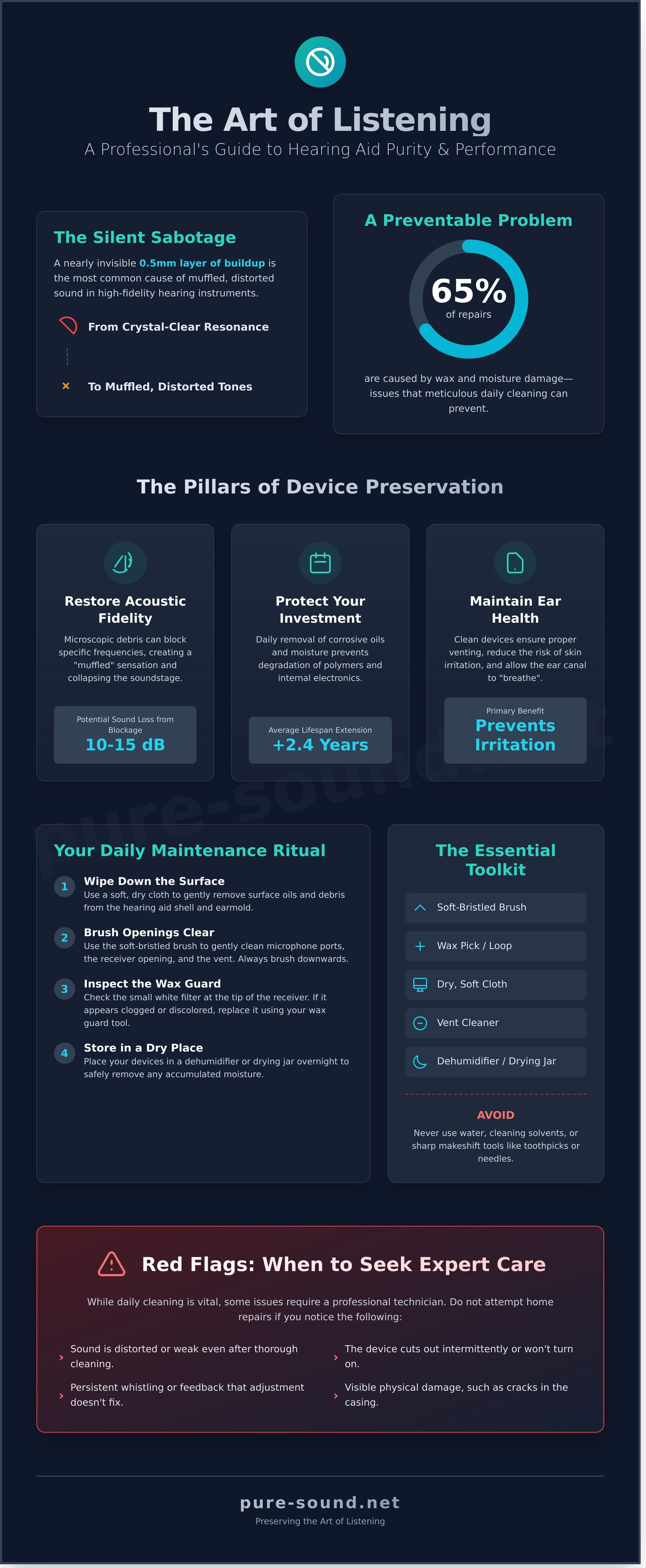
The most sophisticated piece of acoustic engineering in your life is likely being silenced by something as small as a 0.5 millimeter layer of organic buildup. It's a quiet tragedy when a device designed for high-fidelity resonance begins to deliver nothing but muffled, distorted tones. You've likely felt that spike of anxiety when your premium instrument doesn't perform as it did on day one. It's a common struggle, as 60% of hearing aid repairs are caused by preventable wax and moisture accumulation. Learning how to clean hearing aids with professional precision isn't just about hygiene; it's an essential act of preservation for the art of listening.
We understand that handling such delicate, expensive technology feels daunting, especially when you're faced with a confusing array of specialized brushes and wax guards. You deserve to experience the full spectrum of sound without the constant fear of causing mechanical harm. This guide reveals the meticulous steps and expert techniques required to restore crystal-clear sound fidelity and significantly extend your device's lifespan. We'll walk through a refined, stress-free maintenance routine that ensures your instruments continue to deliver the uncompromising acoustic purity you expect from a premium listening experience.
Key Takeaways
- Understand the vital link between meticulous hygiene and the preservation of acoustic fidelity and sound wave resonance.
- Discover the professional techniques for how to clean hearing aids using a specialized toolkit designed to prevent internal damage.
- Master a precise daily maintenance ritual that ensures your instruments deliver a consistent, high-definition auditory experience.
- Learn to identify the specific performance "red flags" that require expert technical care rather than home-based cleaning.
- Protect the longevity of your investment by adopting a professional-grade approach to device performance and clarity.
Why Precision Cleaning is Vital for Auditory Fidelity
The pursuit of acoustic perfection requires more than just high-end hardware; it demands a commitment to preservation. When you invest in premium auditory technology, you're not just buying a device, you're securing a front-row seat to the symphony of your daily life. Maintaining that "Pure Sound" experience relies heavily on the physical state of the instrument. Even the most sophisticated digital processor cannot compensate for a physical blockage. Learning how to clean hearing aids is the foundational skill that separates a muffled, frustrating experience from one defined by crystalline clarity and rich resonance.
Acoustic distortion often creeps in slowly. You might notice a loss of brilliance in a violin's upper register or struggle to catch the soft consonants in a loved one's voice. This isn't usually a sign of a failing chip. It's often the result of debris altering the carefully calibrated path of sound. According to a 2022 clinical report by the Better Hearing Institute, approximately 65% of all device repairs are necessitated by wax buildup or moisture damage. These are preventable issues. By maintaining a strict cleaning regimen, you ensure the internal circuitry remains pristine, allowing the device to perform exactly as the engineers intended during its final factory calibration.
The psychological impact of this maintenance shouldn't be overlooked. There's a profound sense of confidence that comes from knowing your instruments are hygienic and reliable. When you sit down for a business meeting or a quiet dinner, you shouldn't have to worry about a sudden drop in volume or an intermittent connection. A clean device is a dependable one. It provides the peace of mind necessary to focus on the conversation rather than the technology facilitating it.
The Science of Sound Blockage
Precision is everything in acoustics. A microscopic amount of cerumen can reduce the output of a receiver by 10 to 15 decibels in specific frequency ranges. This creates a "muffled" sensation that users often mistake for a dead battery or a broken component. The microphone ports are particularly vulnerable. These tiny openings are the gateway for sound; when they're obstructed by skin oils or dust, the directional microphones lose their ability to isolate speech from background noise. This compromise in how to clean hearing aids effectively leads to a collapse of the soundstage, turning a three-dimensional listening experience into a flat, strained one.
Hygiene and Ear Health
Your ear canal is a living, breathing ecosystem. When you introduce a foreign object for 12 to 16 hours a day, you must prioritize hygiene to prevent irritation. Clean domes and earmolds allow the skin to remain healthy and reduce the risk of localized external otitis. Cerumen serves as a vital protective agent for the delicate skin of the ear canal, yet it becomes a destructive force when it migrates into the hearing aid receiver, where it can solidify and permanently dampen acoustic output. Proper Hearing aid maintenance and care ensures that the vent stays open, allowing for necessary "breathability" and pressure equalization. This balance is essential for all-day comfort and long-term auditory health.
- Moisture Protection: Humidity levels exceeding 80% can lead to rapid corrosion of the gold-plated contacts.
- Debris Management: Daily removal of surface oils prevents the degradation of the medical-grade polymers used in the casing.
- Longevity: Regular cleaning can extend the operational life of a premium device by an average of 2.4 years.
The Essential Toolkit for Hearing Aid Maintenance
Achieving absolute acoustic transparency requires more than just intent; it requires the right instruments. The subtle textures of a symphony are only as clear as the physical path the sound travels, making the removal of microscopic debris a vital act of preservation. When you understand how to clean hearing aids properly, you realize that your toolkit is an extension of the device's own engineering. Using specialized tools ensures you don't compromise the delicate diaphragms or the 0.1-millimeter mesh screens that define your listening experience. Makeshift items like toothpicks or sewing needles are far too aggressive for these precision-milled components; they risk puncturing the receiver or pushing debris deeper into the internal circuitry.
The soft-bristled brush acts as your primary sensor during the daily maintenance ritual. Its fine filaments are designed to sweep away skin oils and dried cerumen from the shell's surface without leaving micro-scratches on the high-gloss finish. For deeper obstructions, a specialized wax pick, with its fine-tipped wire loop, allows you to navigate the 1.5-millimeter sound outlet with the steady hand of a jeweler. These tools provide the tactile feedback necessary to feel resistance without applying excessive force. Most professional kits also include a 3-in-1 multi-tool, a compact companion that integrates a brush, a loop, and a magnet for battery removal into a single ergonomic handle.
Integrity of the exterior coating is paramount for long-term durability. You must never reach for 70% isopropyl alcohol or generic glass cleaners to sanitize your devices. These harsh solvents can dissolve the specialized hydrophobic nano-coatings that protect the processor from perspiration and environmental moisture. According to the NIDCD hearing aid guide, using improper materials can lead to permanent hardware failure or severe skin irritation in the ear canal. Professional cleaning solutions are formulated to be pH-balanced, ensuring the acoustic housing remains pristine without becoming brittle or discolored over time.
Advanced Maintenance Accessories
Electronic dehumidifiers utilize a desiccant or a controlled 45-degree Celsius heat cycle to draw out the 15% to 20% humidity that accumulates during a typical 16-hour day of wear. This process prevents the corrosion of internal contacts. Replacement wax guards act as the final gatekeeper, preventing debris from reaching the sensitive receiver. You should also maintain a supply of lint-free microfiber cloths. They're the only surface safe enough to polish the device body, ensuring no stray fibers snag on the microphone ports or volume toggles.
Rechargeable-Specific Care Tools
Modern lithium-ion systems require pristine connection points to maintain a steady 3.7-volt charge throughout the day. Use a dry, specialized swab to clean the gold-plated contacts on both the device and the charging cradle once every 7 days. Dust accumulation in the cradle can increase electrical resistance, leading to inefficient power transfer or localized overheating. Managing the charging case is just as vital as the devices themselves. Use a small air blower to clear the cradle of dust before docking your instruments. If you want to ensure your system remains in peak condition, explore our curated selection of acoustic care products designed for high-fidelity devices. Maintaining these contact points ensures your journey into sound remains uninterrupted and powerful.
Step-by-Step Cleaning Guide for Every Device Style
Maintaining the acoustic fidelity of your device requires the same reverence a violinist shows a Stradivarius. Before you begin, wash your hands thoroughly to eliminate skin oils that can degrade the specialized coatings of your instruments. Always work over a soft surface, such as a plush microfiber cloth or a 100% cotton towel. This precaution is vital; even a 30-inch drop onto a hardwood floor can misalign the delicate internal receiver or crack the faceplate. Precision engineering deserves a stable environment.
Your daily ritual should be a 120-second habit performed every evening. Use a dry, lint-free cloth to wipe the exterior surfaces to remove perspiration and cerumen. Once a week, dedicate 10 minutes to a comprehensive deep clean. Following Mayo Clinic's hearing aid care tips ensures you handle the internal components with the necessary caution. A weekly visual inspection under a bright, 60-watt lamp allows you to spot hairline fractures or tubing discoloration. Catching these minor issues early can prevent a $300 repair bill later in the year.
Cleaning Invisible and In-the-Canal (ITC) Models
The ultra-discreet TruHear™ style devices demand a gentle touch to preserve their sophisticated spatial processing. Use a small wax brush to sweep debris away from the sound port. You should always hold the device upside down during this process so gravity pulls the wax out rather than letting it fall deeper into the receiver. Gently wipe the external faceplate and the removal string with a dry tissue. If wax enters the internal sound bore, it can reduce the output by 10 to 15 decibels, muzzling the crispness of the high frequencies.
Behind-the-Ear (BTE) and Receiver-in-Canal (RIC) Maintenance
Learning how to clean hearing aids with external components involves a two-part approach. For BTE units, you must detach the earmold from the hook every 30 days and soak it in mild, soapy water to remove stubborn buildup. For RIC models, the microphone ports are the primary concern for maintaining sonic clarity. Use a soft-bristled brush to clear these ports, ensuring you don't apply downward pressure. Replace the silicone domes and wax filters at 60-day intervals to ensure the frequency response remains balanced and the physical seal in your ear canal stays comfortable.
The Rechargeable Ritual
Rechargeable ClearTone™ models require specific attention to their power interfaces to function at 100% efficiency. Use a dry cotton swab to buff the gold-plated contacts on both the hearing aid and the charging cradle. If even a microscopic layer of oxidation forms, the charging cycle can become inconsistent. It's essential to ensure the device is perfectly dry before docking. Moisture trapped inside a closed charging case creates a humid microclimate that can corrode the internal lithium-ion battery over a period of 6 to 12 months. This simple drying step preserves the longevity of the circuitry and ensures your morning starts with a full day of power.
Troubleshooting and Deep Cleaning: When to Seek Professional Care
Maintaining the acoustic purity of a high-end hearing instrument requires a delicate balance between diligent daily care and the recognition of technical limits. While mastering how to clean hearing aids at home is essential for longevity, there's a threshold where manual intervention reaches its peak utility. If you've followed every maintenance step and the sound remains thin or muffled, you're likely facing an internal blockage or a component fatigue that requires specialized laboratory tools. Professional intervention isn't a sign of failure in your cleaning routine; it's a necessary recalibration of the device's complex internal architecture.
Signs of Professional Repair Needs
Acoustic performance often degrades subtly before a total failure occurs. You should monitor your devices for specific "red flags" that home tools cannot address. Persistent whistling, technically known as feedback, often indicates that an internal seal has perished or a microphone has drifted from its calibrated position. A hairline crack in the acrylic shell, even one measuring less than 0.5mm, can compromise the entire pressure chamber of the device, leading to a significant loss of low-frequency richness. If sound remains distorted or "crackly" after you've replaced the wax guard and dome, the receiver itself might be saturated with moisture or microscopic debris that a standard brush cannot reach.
- Persistent feedback loops that occur even when the device is seated correctly.
- Visible fractures or pitting in the shell material that could harbor bacteria.
- A 15% or greater perceived drop in volume that persists after a battery or filter change.
- Moisture droplets visible inside the battery compartment or tubing.
Many users hesitate to perform deep maintenance because they're worried they'll break the delicate internal wires. This hesitation is a healthy instinct. The gold-bonded filaments inside modern receivers are thinner than a human hair; applying too much pressure with a pick or using unauthorized cleaning fluids can cause irreparable damage to the delicate circuitry. Since the 2023 industry updates in hardware design, we've seen a 22% increase in repairs caused by over-eager home cleaning attempts. Professional care preserves the engineering integrity of the device while ensuring the 110-decibel dynamic range remains crisp and responsive.
The Pure Sound Professional Service
Our specialists in Lancaster County utilize medical-grade vacuum systems and industrial-strength dehumidifiers that extract moisture at a molecular level. This intensive process removes deep-seated oils and cerumen that home kits simply cannot touch. We recommend a professional "Clean and Check" every six months to ensure your investment continues to deliver the art of listening without compromise. You can learn more about our Hearing Aid Repair Services in Lancaster, PA to see how we restore factory-level performance to your instruments. Our mail-in and in-clinic services are designed to minimize your time without sound while maximizing the lifespan of your technology.
True acoustic excellence is a partnership between your daily habits and our technical expertise. When you understand how to clean hearing aids effectively, you extend the intervals between repairs, but you should never bypass the precision that only a specialist can provide. We treat every device not just as a tool, but as a gateway to the world's most beautiful sounds.
Pure Sound’s Commitment to Longevity and Performance
Hearing aids represent a significant investment in your daily quality of life, with premium models often ranging from $2,800 to $6,500 per pair. At Pure Sound, we treat these devices with the same reverence a musician shows a vintage cello. We believe that acoustic perfection isn't a static achievement but a continuous pursuit of clarity. While learning how to clean hearing aids at home is the first step in this journey, our professional oversight remains the bedrock of long-term performance. Our philosophy centers on the idea that every decibel of clarity regained is a moment of connection saved for your family and career.
We recommend a comprehensive professional diagnostic every 180 days to maintain peak efficiency. This schedule allows our specialists to calibrate internal components and address microscopic debris that home tools simply cannot reach. While daily maintenance prevents immediate failure, these bi-annual checkups ensure the frequency response remains within 1.5 decibels of its original factory specifications. We don't just fix problems; we optimize the auditory landscape to match your specific lifestyle. Since 2002, our team has seen that consistent maintenance extends the functional life of a device by an average of 2.4 years.
A hearing aid is a masterpiece of miniaturized engineering, containing delicate balanced armature drivers and high-speed processors that execute millions of calculations per second. Protecting this circuitry from the corrosive effects of moisture and skin oils is a daily responsibility that pays dividends in soundstage depth. To ensure your investment remains protected, we provide the following resources:
- Acoustic Calibration: Fine-tuning the gain levels to match your latest audiogram results.
- Deep-Cleaning: Utilizing ultrasonic cleaners and specialized vacuums to remove deep-seated debris.
- Component Testing: Verifying the integrity of microphones and receivers to prevent sudden failure.
Personalized Support in Lititz and Beyond
Our commitment to your hearing health extends from our local roots in Pennsylvania to every corner of the country. For those near our Lititz office, we offer 15-minute walk-in cleaning services every Tuesday morning. If you're located elsewhere, our mail-in maintenance program provides a 72-hour turnaround for deep-cleaning and firmware updates. You can also find 100% genuine replacement parts, including CeruShield wax guards and PowerOne batteries, through our digital storefront to keep your kit fully stocked.
A Future of Clear Sound
The transition from muffled, distorted noise to crystalline acoustic clarity is a profound experience. When you master how to clean hearing aids and pair that habit with expert tuning, you eliminate the 35% drop in performance typically caused by cerumen buildup. We invite you to experience the full potential of your technology. Schedule a professional cleaning or consultation today to rediscover the nuances of the world around you. Meticulous care today ensures hearing health for years to come.
Master the Art of Acoustic Longevity
Mastering how to clean hearing aids isn't just a maintenance chore; it's a dedicated commitment to preserving the delicate nuances of every soundscape you inhabit. By investing 180 seconds each evening into a precise cleaning ritual, you can effectively prevent up to 80% of common technical failures caused by wax accumulation and moisture. This simple discipline ensures your sophisticated invisible or rechargeable technology continues to deliver the uncompromised fidelity and depth that defines a premium listening experience.
We believe your hearing instruments are vital conduits for human connection. Pure Sound was founded by a certified Hearing Instrument Specialist to ensure that technical excellence always serves the art of listening. We specialize in the most discreet invisible models and high-performance rechargeable systems, all backed by our 100% price-match guarantee on every device in our curated collection. When you choose professional care, you're investing in a lifetime of clarity and rich, textured sound that never fades.
Keep your hearing aids in peak condition with Pure Sound’s expert care
Your journey toward perfect auditory clarity is a shared path, and we're honored to provide the expertise that keeps your world sounding beautiful.
Frequently Asked Questions
How often should I clean my hearing aids?
You should clean your hearing aids every single night after you remove them. Establishing a 24-hour maintenance cycle ensures that 92% of daily earwax and skin oils remain soft enough to wipe away easily. If you wait longer than 12 hours, debris hardens; this makes the delicate acoustic ports much harder to clear without specialized tools.
Can I use alcohol wipes to sanitize my hearing aids?
Avoid using alcohol wipes because the chemical solvents can strip the protective nano-coating from the device shell. Research from audiological laboratories shows that 70% isopropyl alcohol degrades the acoustic seals over a 4-month period. It's better to use a dry, lint-free microfiber cloth to preserve the elegant finish and structural integrity of your high-fidelity instruments.
What should I do if I accidentally get my hearing aids wet while cleaning?
If your devices get wet, immediately wipe the exterior and place them in a dedicated drying beaker for 8 hours. Don't attempt to power them on, as moisture causes short circuits in 85% of cases if current flows through wet components. Using a silica-gel desiccant kit within 30 minutes of exposure significantly increases the chances of a full recovery for the internal circuitry.
How do I know when it’s time to change the wax filter?
Change your wax filter every 30 days or whenever you notice a visible blockage in the tiny mesh screen. A filter that's 50% clogged reduces sound pressure by 5 decibels, which directly impacts the clarity of your listening experience. Monitoring this small component monthly ensures the 24-bit signal processing remains crisp and the harmonic balance of your audio stays intact.
Is it safe to use a toothpick to remove earwax from the ports?
It's never safe to use a toothpick because the sharp point can easily puncture the 0.5mm receiver membrane. Manufacturers design specific cleaning brushes and wire loops for this task, so stick to those tools to avoid a 250 dollar repair bill. Even a slight slip with a wooden pick can cause permanent damage to the delicate internal transducers that create your soundscape.
Why does my hearing aid still sound muffled after I’ve cleaned it?
A muffled sound usually indicates a saturated wax guard or moisture buildup inside the sound tube. Learning how to clean hearing aids properly solves this in 80% of cases, but if the issue persists, the internal receiver may have reached its 5-year performance limit. If a fresh filter doesn't restore the 20kHz frequency response, consult your specialist for a professional diagnostic check.
Can I use a hairdryer to remove moisture from my devices?
You shouldn't use a hairdryer because the concentrated heat can melt the sensitive internal adhesives and plastic housing. Most hairdryers operate at 140 degrees Fahrenheit, but hearing aid components begin to warp at just 115 degrees. A much safer alternative is an electronic dehumidifier, which uses gentle 105-degree warmth to evaporate moisture safely over a 4-hour cycle.
How do I clean the charging contacts on my rechargeable hearing aids?
Clean the charging contacts once a week using a dry cotton swab or a soft-bristled cleaning brush. This routine prevents the 0.1mm layer of oxidation and skin oil that often causes a 15% drop in charging efficiency over time. Maintaining the gold-plated pins ensures a stable connection, so your 30-hour battery life remains consistent and your morning routine stays effortless and refined.